

How Side Business Income Can Expand Retirement Contribution Opportunities
Many professionals believe that once they have maximized contributions to their workplace 401(k), they have reached the limit of how much they can contribute to retirement accounts for the year. Because retirement plans often focus on the annual employee contribution limit, it is easy to assume that this number represents the ceiling on total retirement savings.
In reality, the tax rules governing retirement plans are more nuanced. The IRS distinguishes between employee contributions, which are limited per individual across all plans, and employer contributions, which are generally calculated separately for each employer. This distinction can create additional planning opportunities for individuals who earn income from more than one source.
Today, many professionals maintain a traditional W-2 job while also earning income from consulting, real estate activity, freelance work, or other entrepreneurial ventures. This situation is increasingly common among professionals whose careers combine traditional employment with entrepreneurial or project-based work, creating multiple sources of income and additional planning opportunities. When these side activities generate legitimate business income, the business may be able to establish its own retirement plan and make employer contributions based on the income it produces.
This structure allows individuals with side income to contribute meaningfully more to retirement accounts than would otherwise be possible through a single workplace plan. Understanding how these contribution limits interact can help individuals with multiple income sources increase tax-advantaged retirement savings while maintaining a coordinated financial strategy.
Understanding the Two Contribution Limits
The IRS regulates retirement plans using two separate limits that often get confused. The first limit governs employee elective deferrals, which are the contributions employees voluntarily defer from their salary into a retirement plan such as a 401(k). In 2026 the limit is $24,500 with additional catch-up contributions for those aged 50 or older. These contributions are limited per individual regardless of how many employers a person has. Once the employee deferral limit is reached, additional elective deferrals generally cannot be made to other plans.
The second limit governs employer contributions, which are contributions made by an employer on behalf of the employee. These limits apply separately to each employer. When an individual has both a primary job and a side business, each entity may potentially make employer contributions within its own limits.
Because a side business is typically treated as a separate employer, this structure can create the ability to increase retirement contributions meaningfully.
Example 1: A Realtor With a Traditional Career
Consider Sarah, who works full-time as an operations manager for a local company while also maintaining a real estate practice on evenings and weekends. Her real estate activity produces steady income and is reported as self-employment income.
Sarah earns $150,000 in salary from her primary job and contributes the maximum employee deferral to her employer’s 401(k). Her employer also provides a matching contribution.
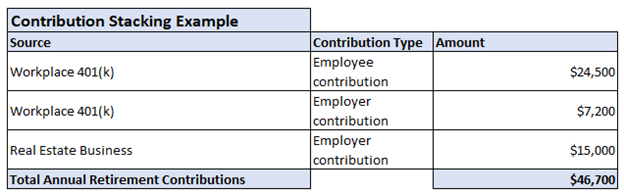
Sarah’s real estate business produces approximately $75,000 of net income. Retirement plans for self-employed individuals generally allow employer contributions of approximately 20 percent of adjusted net self-employment income, subject to annual plan limits. In Sarah’s case, that produces an additional contribution opportunity of approximately $15,000. Even though she has already maximized her workplace 401(k) employee contribution, her side business allows additional retirement savings through employer contributions.
Example 2: A Software Engineer With Consulting Income
Michael is a senior software engineer who earns $220,000 from his primary employer. In addition to his full-time position, he performs consulting work for smaller companies and startups. His consulting activity generates approximately $120,000 in net income each year.
Michael contributes the maximum employee deferral to his workplace 401(k), and his employer provides a modest contribution as well. Because his consulting work is structured as a separate business activity, it may also establish its own retirement plan.
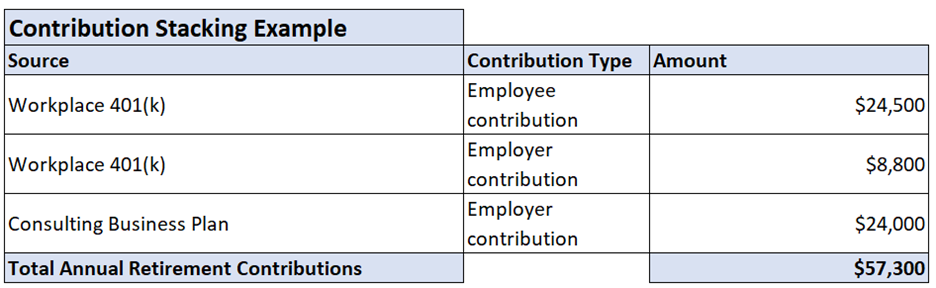
Michael’s consulting income allows a retirement contribution of roughly twenty percent of net business income, resulting in approximately $24,000 of additional tax-advantaged savings. When combined with his workplace contributions, the structure allows him to place more than $57,000 per year into retirement accounts.
For professionals with substantial side income, this structure can meaningfully increase long-term retirement savings and tax efficiency.
Retirement Plan Options for Side Businesses
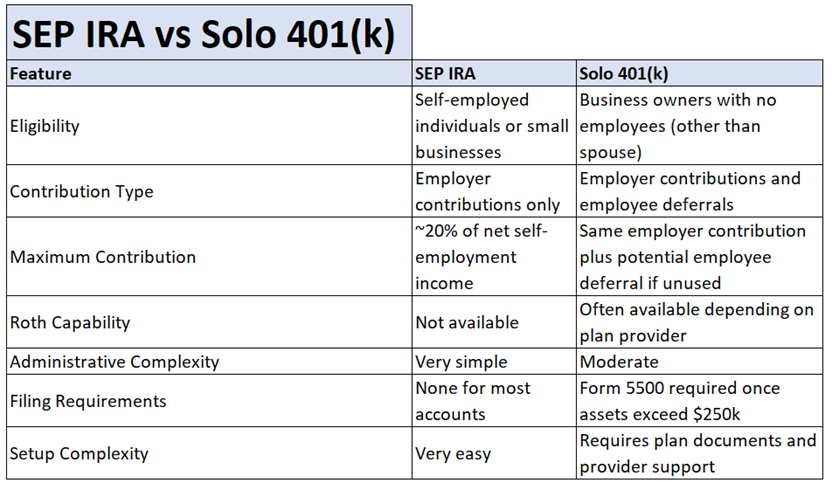
When individuals establish retirement plans for self-employment income, two structures are commonly used: the Solo 401(k) and the SEP IRA. Both allow employer contributions based on business income, but they differ in flexibility, complexity, and interaction with other planning strategies.
Both structures allow employer contributions based on self-employment income, which means the retirement savings opportunity created by the side business is similar in many cases. However, the Solo 401(k) provides greater flexibility, particularly because it may allow employee contributions, Roth features, and avoids the IRA pro-rata rule that can complicate Backdoor Roth strategies.
Final Thoughts
Many financial discussions focus primarily on investment returns. In our experience, meaningful financial progress often comes from coordinating multiple aspects of a client’s financial life, including tax planning, retirement plan design, and overall cash-flow strategy.
For individuals who earn income from more than one source, a properly structured retirement plan can create opportunities to increase tax-advantaged savings beyond what is available through a single employer plan. These opportunities are often overlooked because they require coordinating business income, retirement plan rules, and long-term financial planning rather than focusing solely on investment selection.
At HFG, our role as fiduciary advisors is to help clients evaluate strategies like these in the context of their broader financial picture. We regularly work with individuals and business owners to design and implement retirement plans—including workplace plans, Solo 401(k)s, and SEP IRAs—while coordinating closely with clients and their tax professionals to ensure that retirement savings strategies align with broader financial goals.
For individuals with profitable side income, evaluating whether a separate retirement plan may be appropriate can be an important part of a coordinated long-term financial strategy.